Cost, Commitment and Convenience in AI Sex Chat
The honest way to account for adult AI chat is in minutes and messages, because that is the currency every reader spends the same way. Sixteen sessions a month at half an hour each is 8 hours of attention, and the questions worth asking are what those hours buy you, what convenience removes from the overhead, and what kind of commitment they quietly create.

Key takeaways
- Sixteen sessions at 30 minutes is 480 minutes, or 8 hours a month — the base unit this article works from.
- Forty messages a day for 30 days is 1,200 messages, which puts the same 8 hours at about 24 seconds per message.
- Setup time listed separately stops pretending it is free: two minutes every session is 32 minutes a month, or 6.7% of the total.
- A card that converts 0.029% of its views into favourites, such as 7.1K against 24.3M, is one readers keep rather than merely open.
The three costs a session imposes
Crushon frames its characters as Sex AI companions, and that framing sets a useful expectation about scale before any schedule arithmetic begins. Time is the obvious cost and the easiest to underestimate. A month built on four sessions a week spends 16 separate occasions, and each occasion carries a cost beyond its length: deciding to start, choosing the character, opening the thread. That overhead is small per visit and large per month, which is why readers who describe the habit as heavy are usually describing frequency rather than duration.
Attention is the second cost, and it behaves differently. Half an hour of active writing is not interchangeable with half an hour of occasional replies, because the value of a session comes from what you put in. A short session with a clear premise tends to produce a more coherent thread than a long one where the thread drifts while you are elsewhere.
The third cost is continuity. Characters on Crushon are described as recalling earlier interactions, which means a session has a relationship to the sessions before it. That is a benefit and a commitment at the same time: what you established yesterday shapes today, so an inconsistent habit produces inconsistent results regardless of how many hours it contains.
What convenience actually removes
Convenience is not a vague quality; it is the removal of specific frictions. A search route with tag filters removes the cost of hunting through unfamiliar cards. A saved list removes the cost of remembering what you liked. A device that is already signed in removes the cost of starting. Each of those saves seconds, and seconds accumulate across 16 sessions into a real monthly figure.
The honest counterweight is that convenience raises frequency, and frequency is where the hours come from. If your monthly 8 hours were previously 4 because starting was awkward, a frictionless setup does not make the same usage cheaper — it makes the usage larger. That is neither good nor bad on its own. It is simply the mechanism by which convenience changes the size of a habit rather than the price of it.
Commitment without exaggeration
Nothing here requires a long contract. The commitment readers describe is behavioural: a saved library, a returning habit, a set of characters whose contexts are worth keeping. That commitment is generated by repetition, and repetition is measurable. Someone who saves two characters in month one and forty-two by month six has built a library; someone who never saves anything has built nothing to return to, however many hours they spent.
Where the cost stops being worth it is personal and should be checked rather than assumed. A useful test is to compare the hours spent against the number of threads you would genuinely miss if they disappeared. When the second number is zero, the schedule is producing motion rather than value, and the fix is a smaller session count rather than a better plan.
| Dimension | How it is measured | Monthly figure |
|---|---|---|
| Platform time | Sessions per week × minutes × 4 | 16 sessions at 30 minutes is 8 hours |
| Message volume | Messages a day × 30 days | 40 a day is 1,200 a month |
| Time per message | Minutes ÷ messages | 480 ÷ 1,200 is 0.4 minutes, about 24 seconds |
| Setup overhead | 2 minutes × sessions per month | 32 minutes, or 6.7% of 480 |
| Selection overhead | Weekly chart pass × 4 weeks | 10 minutes a week is 40 minutes a month |
Worked example: what eight hours contains
Start with the base unit. Illustrative assumption: 16 sessions a month at 30 minutes each. That is 16 × 30 = 480 minutes, which is 8 hours. Divide by a plausible message volume of 40 a day over 30 days, which is 1,200 messages, and each message represents 480 ÷ 1,200 = 0.4 minutes of platform time, or about 24 seconds. Any reader can redo that arithmetic with their own figures: sessions per month × minutes, then divide by the messages they actually send.
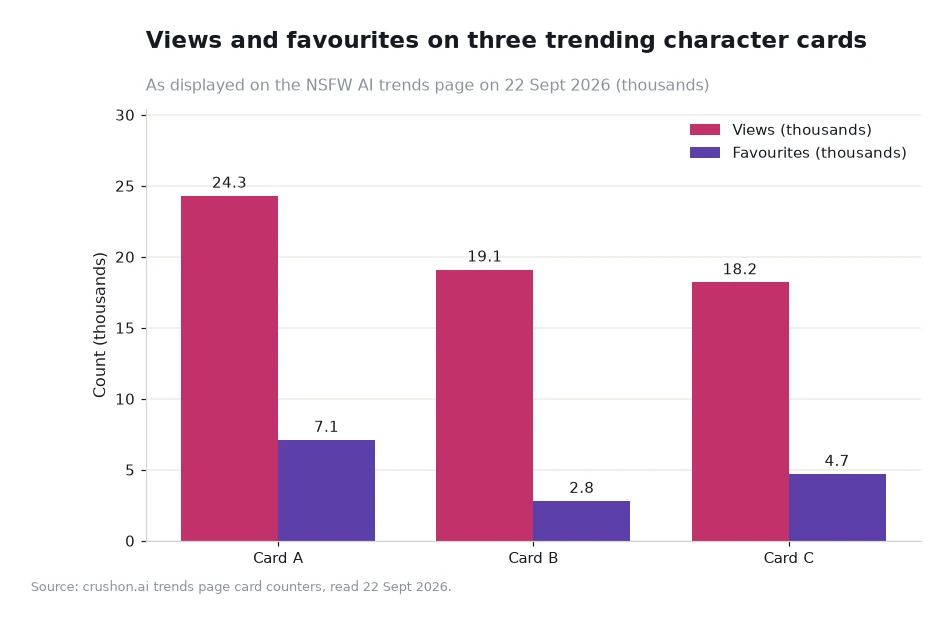
The same 8 hours looks different depending on which cards it feeds. Take the counters published on 22 Sept 2026. Eri displays 24.3M views and 7.1K favourites, and 7,100 ÷ 24,300,000 is about 0.029%. Eva shows 19.1M views and 2.8K favourites, about 0.015%. Takara shows 18.2M views and 4.7K favourites, about 0.026%. If your own month is 16 sessions, a card with a rate closer to 0.026% is more likely to be one you would keep than a card with a comparable view count and a lower favourite rate. The chart below plots those same figures.
Fitting a sex ai routine around your week
Work backwards from the week rather than forwards from the platform. Decide how many sessions are realistic, multiply by the length you enjoy, and check the total against the hours you would call reasonable for any other hobby. Sixteen sessions at 30 minutes is a moderate month; sixteen at 60 minutes is 16 hours, which is a different commitment entirely, even though the session count is identical.
Then look at what the platform already provides so you are not paying setup costs twice. Tag filters and a saved list reduce selection overhead, and the unlimited plan page sets out what an upgraded arrangement includes if your usage outgrows the default. The AI chat blog covers features in more detail when a mechanism is unclear, which is usually cheaper in time than learning it by trial across several sessions.
Frequently asked questions
How much time does a typical month actually take?
On the illustrative 16-session month, 8 hours at 30 minutes per session. Halving the session length halves it to 4 hours; doubling it doubles it to 16, so session length is the variable with the largest effect.
Does convenience make the habit more expensive?
It makes it larger, not dearer. Removing friction tends to raise the number of sessions rather than the length of each one, which is why a setup that feels effortless can quietly double the monthly hours.
What should I watch for if usage grows?
Compare hours against threads you would genuinely miss. Growth in hours with a flat count of saved characters usually means sessions are being started and abandoned rather than developed.
Set the budget in minutes first
Decide the hours before you open a tab, because the arithmetic is trivial and the drift is not. Track sessions and messages separately for one month, compare the total against what you expected, and adjust the session length rather than the frequency, since length is the lever that moves the total fastest. If the numbers still surprise you, the surprise is the useful part of the exercise.
Data and sources: card counters shown on the Crushon trends page[1], read 22 Sept 2026. Hours, message counts and overheads are illustrative assumptions, not platform data. This guide is for an adult readership of 18 and over.