A private label perfume quote is a summary of a scope, and the scope is where the margin is decided. Two suppliers can quote the same unit price for projects that differ by decoration, testing, documentation and packaging inclusions. For an EU-compliant launch the difference matters twice, because some cost lines also carry documents that have to exist before the product can be placed on the market. Read the breakdown line by line, and the quote stops being a number and becomes a plan.
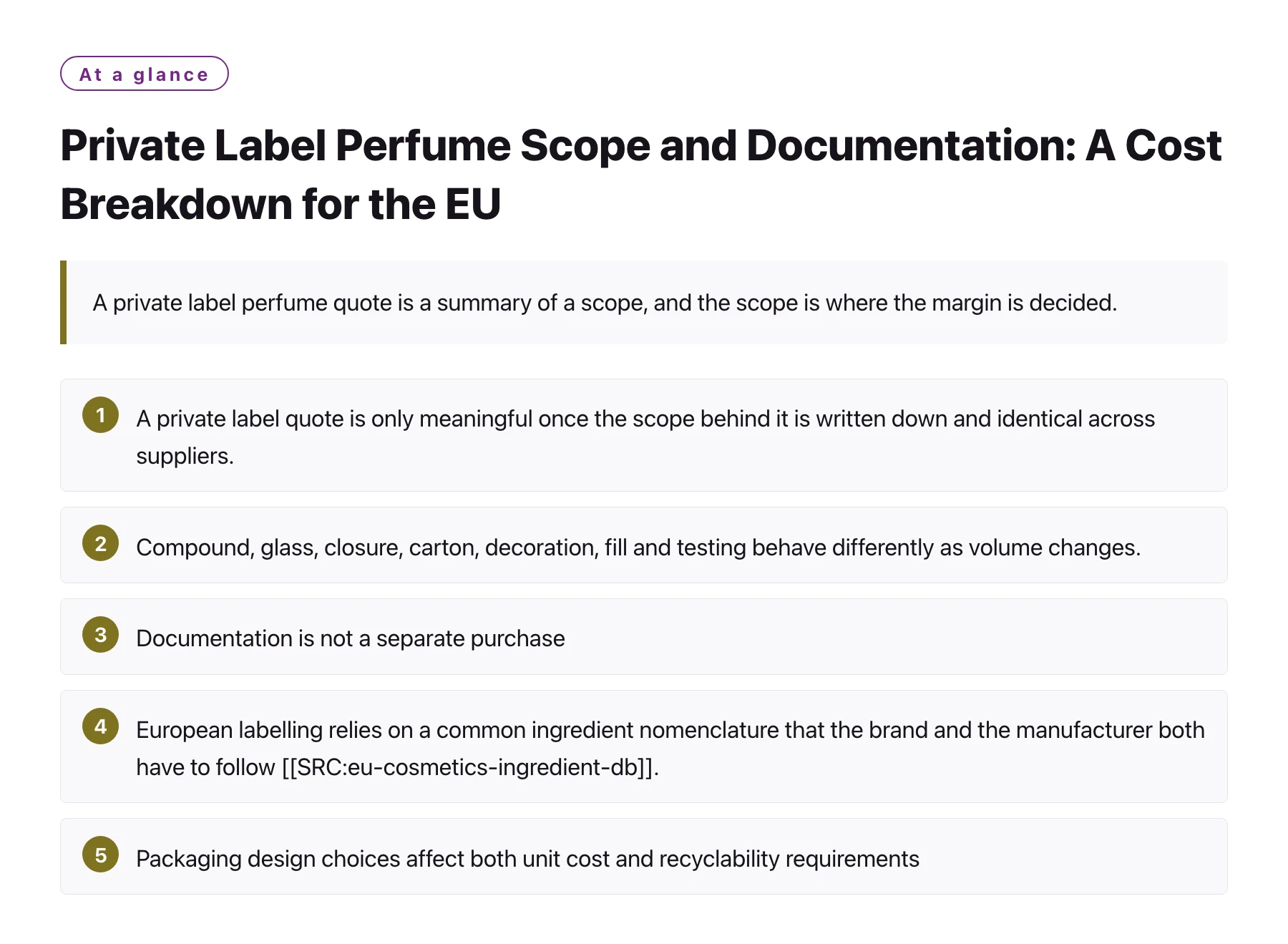
Key takeawaysA private label quote is only meaningful once the scope behind it is written down and identical across suppliers. · Compound, glass, closure, carton, decoration, fill and testing behave differently as volume changes. · Documentation is not a separate purchase; it attaches to specific cost lines and to specific parties. · European labelling relies on a common ingredient nomenclature that the brand and the manufacturer both have to follow [1]. · Packaging design choices affect both unit cost and recyclability requirements, so they belong in the same conversation as the price.
Private label is often presented as the simple route: pick a formula, pick a bottle, put your name on it. The simplicity is real at the start and misleading at the cost stage, because the same phrase covers projects with very different amounts of development, decoration and documentation.
The effect is that quotes are compared as though they describe the same thing. In practice one quote assumes a stock bottle and a paper label, another assumes a custom mould and a decorated cap. The higher number is sometimes the cheaper project.
This breakdown sets out the lines that make up a private label order for the European market, what each one includes, and which lines carry documentation the brand will be asked to produce.
Scope first, then the number
Before requesting a price, write the scope as a list of inclusions and exclusions. Format, fill volume, concentrate load, bottle and closure source, decoration method, secondary packaging, testing responsibility, documentation, shipping terms and order quantity. Each of those changes the price, and each one is easier to fix now than to renegotiate later.
The reason this pays is not only comparison. A written scope also determines who is responsible for what, and on a European launch responsibility is the expensive part to get wrong. Labelling, ingredient naming and product documentation are duties attached to the finished product, and they need an owner on each side.
Once the scope exists, requesting quotes becomes a mechanical exercise and the conversation moves to the parts that actually differ between suppliers: how they work, how they handle deviation, and what they do when a component is late.
Where private label ends and development begins
Private label normally means the brand selects from existing formulas and standard packaging components, with limited customisation. A custom bottle, a new mould or a bespoke scent moves the project toward development work, which has a different cost structure and a longer timeline.
Deciding which parts of the project are genuinely custom is worth an hour early on. A single distinctive element, such as a decorated cap or a printed carton, often delivers most of the perceived difference at a fraction of the cost of changing everything.
It is also worth stating plainly in the scope which components are stock and which are made for the brand. In private label perfume manufacturing the standard components are usually the ones that keep the project repeatable, so anything custom should be justified by a commercial reason rather than by preference.
The cost lines, and what travels with each one
| Cost line | What it covers | How it behaves as volume rises | Documentation attached |
|---|---|---|---|
| Fragrance compound | The concentrate at the agreed load, blended to the selected or developed formula | Falls per unit with larger compound batches, though less than packaging | Material data, safety information for the compound, restricted material position |
| Carrier and filling | Alcohol, water, functional additions where the brief requires them, and the fill operation | Falls steadily; fill changeover is a fixed cost per run | Batch record, fill weight verification, release record |
| Primary packaging | Bottle or container, closure, pump or sprayer, sourced as stock or custom | Falls sharply with volume when a mould is involved, mildly for stock components | Component specification and, where relevant, material statements |
| Decoration | Printing, coating, metallising, labelling or engraving on the filled or unfilled pack | Falls with volume; setup charges dominate at small quantities | Trial and approval record for the decoration |
| Secondary packaging | Carton, sleeve, insert and any gift presentation | Falls with volume; tooling and die costs are front-loaded | Artwork file, dieline, and pack specification |
| Testing and inspection | Stability, compatibility, fill checks and any third-party inspection the buyer requires | Mostly fixed per product, not per unit | Test reports, inspection report, retention of the approved reference |
| Documentation and labelling | Ingredient naming, label content, and the product information the market requires | Fixed per product; changes trigger a reissue | Ingredient list in the common nomenclature, label content approval, market-specific filing |
Two observations follow from the table. First, the lines that fall fastest with volume are packaging and decoration, not the fragrance, which is why a private label project with a distinctive pack benefits more from volume than one relying on a complex formula. Second, the documentation column runs the length of the table rather than sitting at the end, which is why documentation should be scoped with the price rather than added later as a service.
The documentation a European launch actually needs
Documentation for the European market clusters into three groups. The first is product-level: the formula picture, the material data and the ingredient list prepared in the common nomenclature that European labelling uses, which is supported by the Commission's public ingredient database [1]. The second is batch-level: the manufacturing record, fill verification and the retained reference. The third is market-level: label content confirmation and any filing or notification required in the destination countries.
The split matters because different parties own different groups. Manufacturers naturally own the formula and batch documentation; brands own the market-level decisions and normally appoint whoever files on their behalf. Writing that split into the purchase agreement is the single most useful documentation step a private label buyer can take.
Packaging adds a fourth group that is easy to overlook. Material choices, recyclability and pack configuration are increasingly part of the design conversation in Europe, and industry coalitions publish design guidance that is more practical than the regulation itself for day-to-day decisions [2]. A pack that is difficult to recycle is not automatically non-compliant, and it is increasingly a commercial disadvantage.
It is also worth reading the industry association's published positions alongside the rules, because they explain how the sector expects requirements to be implemented in practice [3]. None of this replaces legal advice for a specific market. It reduces the number of questions a brand has to discover late.
How documentation affects unit cost
Documentation is mostly fixed cost per product, which means it is expensive for a single small order and cheap across a range that shares its paperwork. A brand launching several products in one format can often gather a large part of the documentation once and reuse it, provided the formulas and the pack configuration are genuinely similar.
The reverse is also true, and this is where private label budgets surprise people. A late change to the label or the ingredient list triggers a reissue, and a reissue after artwork has been printed is a real cost. Confirming label content before the print run is the cheapest documentation control available.
A useful habit when comparing private label quotes is to ask each supplier to mark, line by line, what is included and what is excluded. Suppliers that welcome the exercise are usually the ones whose scope was already specific. The comparison that results is less flattering to the cheapest headline number and much closer to the truth.
Turning the breakdown into a decision
With the lines itemised, three questions settle the choice. Which line carries the most risk for this product, and which supplier handles it best? Which lines are fixed and which scale, so the price at a reorder can be predicted? And which supplier provides documentation as part of the quoted service rather than as a separate negotiation?
For a first private label order, the answers usually favour a supplier that runs development, filling and packaging as connected work, because the documentation crosses those functions. That is what a buyer should be checking when evaluating choosing a private label perfume partner, and the breakdown is the tool that makes the evaluation concrete.
Background helps as a secondary check rather than a primary one. A house with a long history and a stated certification set, such as Xuelei on a manufacturer's about page, is worth verifying on the same lines as any other candidate. Certifications describe a system; the breakdown describes your product.
None of this makes private label complicated. It makes it legible. The project is a defined scope with a price attached, and the buyer who defines the scope first is the one who keeps control of the margin.
Sources
- EU CosIng — Cosmetic Ingredient Database (European Commission) —— The European Commission's CosIng database of cosmetic ingredients, listing ingredient functions, restrictions and labelling requirements under EU cosmetics law.
- Sustainable Packaging Coalition —— A membership organisation working on more sustainable packaging design, publishing material and recyclability guidance.
- Cosmetics Europe —— The European trade association for the cosmetics and personal care industry, publishing guidance, positions and market information.
Frequently asked questions
Why do private label perfume quotes vary so much between suppliers?
Usually because the scopes differ rather than the margins. Decoration, packaging inclusions, testing responsibility and documentation are the lines that move the number most. Ask each supplier to itemise inclusions and exclusions before comparing totals.
Which private label cost line falls fastest with volume?
Primary packaging and decoration, particularly where a mould or a setup charge is involved. The fragrance compound also falls with larger batches, but less dramatically, which is why a distinctive pack benefits more from volume than a complex formula does.
Who prepares the ingredient list for European labelling?
Normally the manufacturer supplies the material data and the ingredient information, and the brand confirms the label content for the market. The list follows the common ingredient nomenclature used in European labelling, which is supported by the Commission's public ingredient database.
Is documentation included in a private label price?
It should be scoped explicitly. Some suppliers include the material and batch documents as part of the service and quote label content work separately; others bundle everything. Either arrangement can work, provided the split is written down before the order is placed.
Does private label mean the brand cannot customise anything?
No. Private label usually means selecting from existing formulas and standard components, with customisation limited to decoration, cartons and similar elements. A custom bottle or a bespoke scent moves the project into development work, which changes both cost and timeline.