Searching trade records by product can support better commercial research when the question, record type and limits are defined before results are interpreted. Use the data to organize evidence about product-description search across trade records, then verify consequential company, market or route conclusions with sources suited to that decision.
Key takeaways
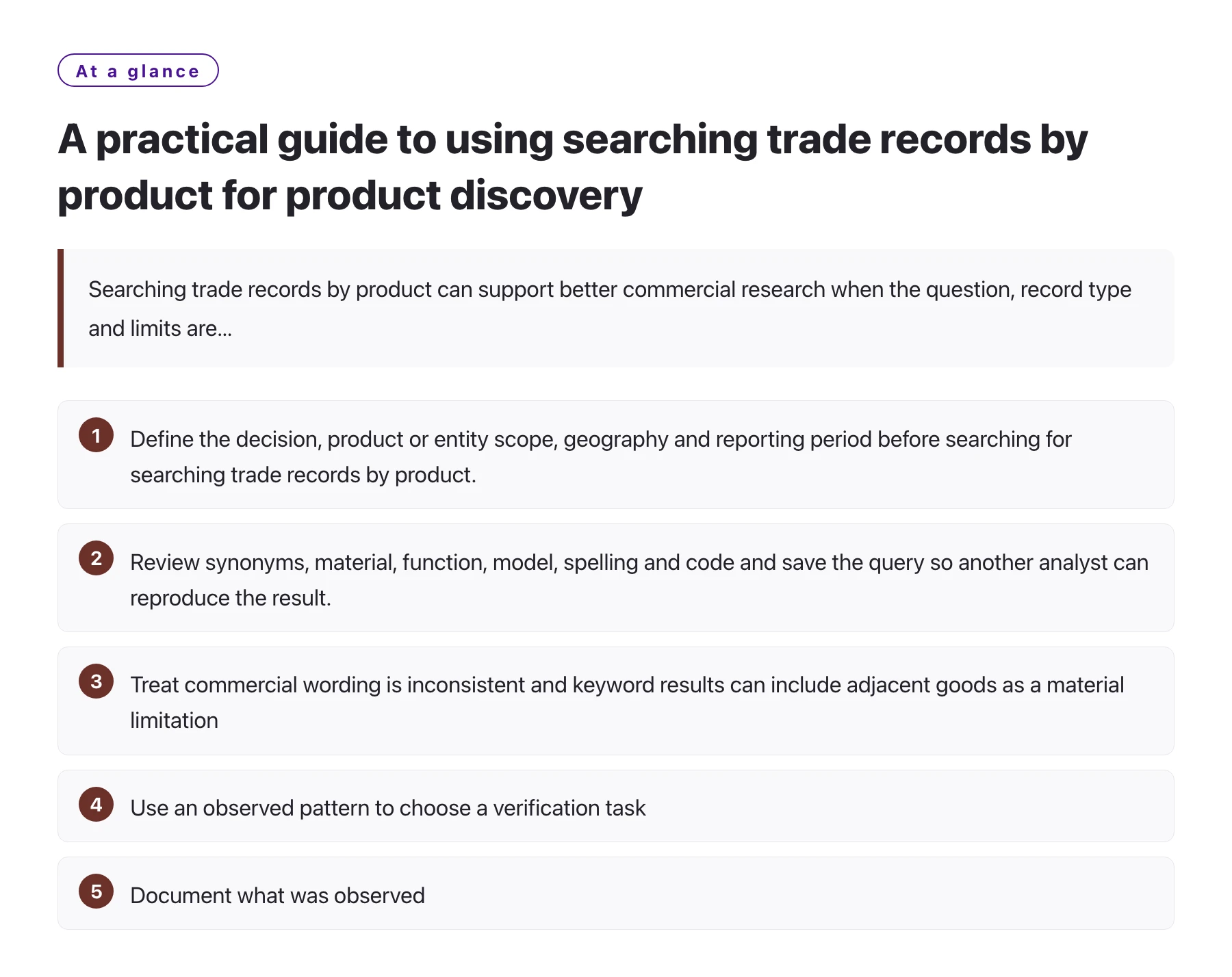
- Define the decision, product or entity scope, geography and reporting period before searching for searching trade records by product.
- Review synonyms, material, function, model, spelling and code and save the query so another analyst can reproduce the result.
- Treat commercial wording is inconsistent and keyword results can include adjacent goods as a material limitation, not a footnote.
- Use an observed pattern to choose a verification task; do not treat it as proof of future demand, current intent or operational capability.
- Document what was observed, inferred and independently verified when applying searching trade records by product to how to review a sample before treating result counts as comparable.
This guide follows one practical principle: select fields only after defining the unit of analysis. The aim is not to turn a dataset into an automatic answer. It is to make a research sequence clearer, so that the evidence can narrow a question, expose gaps and direct the next check.
The scope here is searching trade records by product. That phrase can refer to very different levels of detail, from national totals to individual shipment observations. Before comparing any outputs, establish which level is present and whether the records share a consistent definition.
1. Define the research unit for searching trade records by product
Start by writing down the decision behind the search. For this subject, the central unit is product-description search across trade records. That phrase still needs a practical boundary: specify the product or company scope, the economies involved, the dates, and the kind of record that would count. Without those choices, a large result set can mix observations that do not answer the same question.
Next, state what would make an observation relevant. For searching trade records by product, distinguish a direct match from a nearby category, a likely identity from an unresolved name, and a current signal from an older one. Record accepted synonyms and exclusions before reviewing results. This makes it harder to expand the query selectively after seeing which interpretation supports a preferred outcome.
A useful first pass is deliberately modest: define one decision, one product or entity scope, one geography, and a time window appropriate to that decision. Then write down the expected blind spots. This framing makes the later analysis about how to review a sample before treating result counts as comparable, rather than about collecting the largest possible number of rows.
2. Select fields that explain product-description search across trade records
The key fields for an initial review are synonyms, material, function, model, spelling and code. Do not assume that a search interface uses these labels in the same way across every country or record family. Check the field definitions, coverage notes, units and available dates. A company-name query, an HS-code query and a country-level total are different routes into evidence, even when all are described as trade data.
Keep the first query simple enough to interpret. Search the core product or entity term, inspect a sample of matches, and only then add constraints such as port, partner or shipment interval. Save the exact terms, code edition, filters and result date. If results change after adding a filter, note whether the change reflects a narrower scope or a different data universe. The UN methodological guidance emphasizes recording product classification, valuation and reporting practices when interpreting merchandise statistics. [2]
A platform such as importer data can be considered as one interface for exploring trade records and filtering by relevant dimensions. Match its available fields and country coverage to the question at hand; the presence of a filter does not itself establish that every underlying record is complete or comparable.
3. Separate recorded activity from interpretation
The most important analytical boundary is between what a record states and what a researcher infers. In work involving searching trade records by product, a row may support the statement that a source recorded an event or flow with particular fields. It does not, without more evidence, prove the commercial role, motive, quality, present capacity or future behavior of each named party.
For aggregate merchandise comparisons, review the reporting basis before interpreting changes. The WTO explains that general and special trade systems treat some warehouse and re-export flows differently, and that valuation conventions can also affect comparability. [1] The United Nations methodology materials likewise treat coverage, time of recording, commodity classification, valuation, quantity measurement and partner attribution as distinct compilation questions.
Accordingly, treat commercial wording is inconsistent and keyword results can include adjacent goods. When two sources disagree, do not average them reflexively. Compare definitions, reporting periods and units first; then preserve the discrepancy as a limitation if it cannot be reconciled. A transparent caveat is more useful than a precise-looking figure whose construction is unclear.
4. Turn the result into a testable next step
Once an initial pattern appears, write one hypothesis and one check that could disprove it. A rise in recorded value, for example, may reflect more physical quantity, a different product mix, price changes or a revision. A repeated company appearance may justify identity research, but it does not tell a team who made the purchasing decision. Let the next check follow from the field that generated the signal.
For a market screen, compare candidates under the same product definition and period, then review other relevant evidence such as customer interviews, regulations, duties, local distribution and competitive conditions. For an account or supplier screen, verify legal identity and role with independent sources before outreach or onboarding. For route work, compare the record dates with current operational information rather than treating historical movements as a live schedule.
The practical output should be a short decision note: what was observed, how the query was built, what remains uncertain, and what evidence would change the conclusion. This is how searching trade records by product can inform how to review a sample before treating result counts as comparable without being asked to prove more than the data can support.
5. Preserve a reproducible review
A second analyst should be able to reproduce the search. Keep the source name, access date, query terms, code version, geography, date range, units and exclusions together. If records were exported, preserve the original extract separately from cleaned data. Document normalization rules for company names and product descriptions rather than silently overwriting the source wording.
Use a small quality-control sample before making a broad claim. Check whether descriptions match the intended product, whether apparent company duplicates share an identifier or address, whether quantities use compatible units, and whether dates refer to the same event. Where the dataset exposes revisions or missing periods, record them. These checks are especially important when a chart or ranked list will be shared with colleagues.
Finally, label the conclusion according to its evidence level: observed, inferred, or independently verified. That simple distinction helps teams use searching trade records by product responsibly. It also clarifies what to do next: extend coverage, validate an entity, compare another period, or stop because the evidence is insufficient for the decision.
Sources
Frequently asked questions
Can these records establish future demand?
No. They show reported activity within a source’s scope; future demand requires separate customer, pricing, channel and regulatory research.
Why might two sources show different totals?
Coverage, reporting dates, classification, valuation, trade-system definitions, revisions and record-level inclusion rules can differ.
Does a named company field prove that the company made or bought the goods?
No. The role represented by a field depends on the record and dataset. Verify identity, role and relationship independently.
How should a result be used in a business decision?
Treat it as a screening signal, document the query and assumptions, then corroborate consequential findings with primary or operational sources.